How to Make Up a Bedtime Story in 5 Minutes (Even When You're Tired)
November 2, 2026 · 7 min read
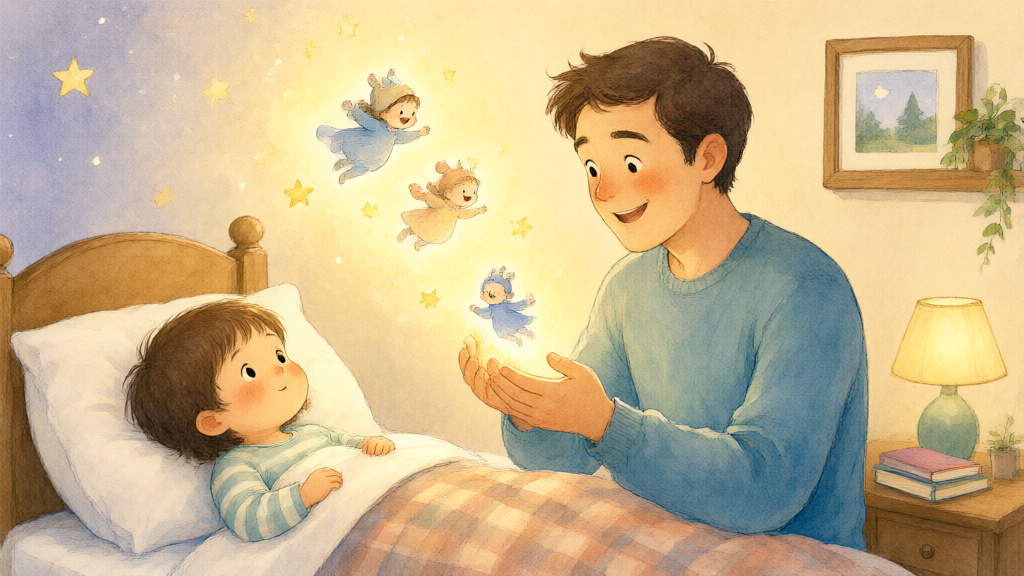
"Tell me a story. No, not from a book. A made-up one." Many parents hear this and feel a small wave of panic. It's the end of a long day, your brain is running on fumes, and suddenly you're supposed to be a children's author.
Here's the secret: kids aren't grading you. A bedtime story made up on the spot doesn't need a clever twist or beautiful sentences. It needs a hero, a small problem, and a cozy ending. Once you know the pattern, you can make up a bedtime story in five minutes, even on your most tired night.
The five-step formula
Almost every good children's story fits this shape. Memorize it and you'll never be stuck again.
- A hero. A little fox, a red tractor, a girl named Maya, your child.
- A place. A forest, a farm, a city at night, the moon, your own backyard.
- A small problem. Something is lost, someone is scared, something is broken, a friend is sad.
- Three tries. The hero tries once and it doesn't work, tries again and it almost works, then tries a third time and it does. The "rule of three" gives a story rhythm and is easy for kids to follow.
- A cozy ending. Problem solved, everyone home, everyone sleepy.
Example in thirty seconds: A little owl named Hoot lost his favorite star. He asked the cloud, but the cloud didn't know. He asked the moon, but the moon was busy. Then he asked the firefly, and the firefly said, "Look in the pond." There was his star, shining in the water. Hoot smiled, said goodnight to the star, and flew home to his nest to sleep.
That's a whole story. Your child will probably ask for it again tomorrow.
Story starters for when your mind is blank
Keep a few of these in your back pocket:
- A teddy bear wakes up in the night and realizes his kid is missing from bed. (Spoiler: she's getting water.)
- A school bus goes to sleep in the garage but can't stop thinking about all the kids it drove that day.
- A snowflake wants to land somewhere special.
- A little dragon is afraid of his own sneeze.
- A puppy gets lost in a pumpkin patch the day before Halloween.
- The moon wants to come down and see what kids do at night.
- A shy turtle is invited to a birthday party.
- A sock goes looking for its missing partner.
Use your child's real life
The easiest story material is your child's own day. Kids love hearing about themselves, slightly transformed.
- Turn the day into an adventure. "Once upon a time, a brave explorer named Leo went to a faraway land called Grandma's house..."
- Rework a small worry. If your child was nervous about a swimming lesson, tell a story about a little duck who was scared of the deep end.
- Bring in their toys. The stuffed giraffe on the bed can be the hero.
- Add a pet or sibling. Kids love a guest appearance from the family dog.
A made-up story is also a gentle way to work through something hard: the dark, a new sibling, starting preschool. A hero who faces the same thing gives your child a picture of how to cope. Our therapeutic stories section has full examples you can borrow ideas from.
Let your child help
Collaborative stories take the pressure off you and often become your child's favorite part of the night.
- Ask questions along the way. "What color was the dragon?" "What did he have in his backpack?"
- Take turns. You say one sentence, your child says the next.
- Let them choose the hero and the place. "Who should the story be about tonight? Where does it happen?"
- Pause before the ending. "And then the little fox... what do you think he did?"
Just keep the final part in your hands. If your child's ending involves a volcano and a robot army, gently steer it home: "And after all that, the robots were very sleepy, so they went back to their robot beds."
Keep it bedtime-friendly
A made-up story for bedtime should calm, not excite.
- No real villains. Use small problems, not big dangers.
- Slow down toward the end. Talk more quietly, use shorter sentences, add sleepy details: yawns, soft blankets, stars.
- End at home. The hero should end the story safe, warm and going to sleep.
- Keep it short. Five minutes is plenty. If your child begs for more, promise "part two" tomorrow.
For more about what works at bedtime, see our guide on how to choose bedtime stories.
Build a series
Some families invent a recurring character who shows up night after night: a bear who lives in the closet and looks after the toys, or a tiny dragon who lives in the backyard. Series take the pressure off because you already know the hero, the place and the friends. All you need is tonight's small problem.
Your child may also start asking for the same story over and over. That's fine. Repetition is comforting, and you don't have to come up with anything new.
When you're truly out of ideas
Some nights the tank is empty. That's okay. You can:
- tell the story of your own day, from your point of view, in a silly way;
- retell a classic like Goldilocks and the Three Bears with your child in it;
- tell the "story of when you were born" (kids never get tired of this one);
- use a ready-made story.
On Winktale you can make a short illustrated story with your child as the hero in a couple of minutes. Pick a theme or a lesson, add your child's name and look, and read it together. It also comes with narration for nights when your voice is gone. Take a look at our short bedtime stories for an example of the length and tone that works best at night, or browse our bedtime stories for toddlers for very young listeners.
Frequently asked questions
What makes a good made-up bedtime story?+
A simple hero, a small problem, three tries and a calm, cozy ending. It doesn't need to be clever or long to work.
How long should a made-up story be?+
Three to five minutes is plenty for most young kids. Promise a “part two” tomorrow if they want more.
Is it okay to tell the same story every night?+
Yes. Kids love repetition, and a familiar story is especially calming at bedtime.
How can I get my child to help make up the story?+
Ask simple questions as you go, let them pick the hero or the place, or take turns adding one sentence each.